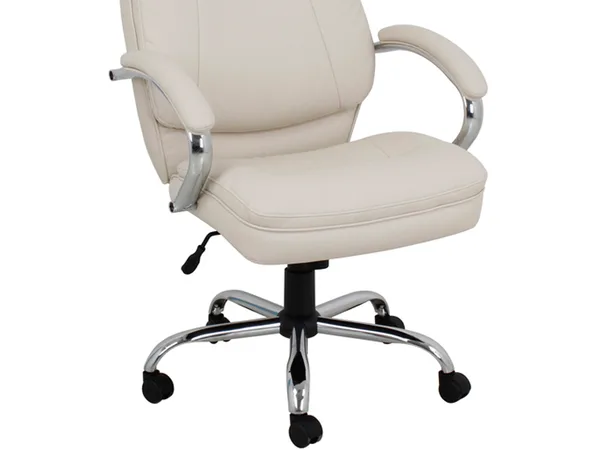
Every dispute we have ever had with a buyer came down to one question: what did we agree the chair would be? When there is a signed sample, the answer is on the table and we resolve it in an hour. When there is not, it becomes opinion against opinion, and nobody wins that. That is why we treat the approval sample — the "golden sample" in trade language — as the most important document in the order, even though it is not paper.
What a golden sample actually is
It is the physical chair you approve before mass production, sealed and signed by both sides, that the whole run gets measured against. Once you sign it, it stops being a sample and becomes the reference standard — the single source of truth for what your chairs should be. The pre-production (PP) sample we send is built on the real tooling and the real materials we will use in production, not a hand-made one-off that looks nicer than what comes off the line. That distinction matters: a polished hand-made sample sets an expectation production cannot meet, and then everyone is unhappy. If the PP sample and the production chairs differ later, the golden sample is what we both point to.
What to check before you sign
Sit in it, yes, but do not stop there — comfort is the easy part to judge and the least likely to cause a claim. Check the things that fail in the field: the gas-lift class and its stamp, the base material and the arm strength, the foam density on a padded office chair, the mesh tension and the edge binding, the stitching and seam strength on a leisure recliner, the mechanism action and recline lock on a gaming chair. Measure the dimensions against your written spec — a chair that passes every strength test but sits 10 mm outside your stated seat-height band still gets rejected by a contract buyer, and you want to catch that on the sample, not on the container.
Photograph everything and write down the tolerances you are agreeing to. A 2 mm colour shift, a half-shade fabric difference, a slight grain variation in leather — these are normal in volume production, and they should be agreed now, in writing, not argued at shipment. The buyers who have the smoothest orders with us are the ones who tell us up front exactly how much variation they can live with. Vague approval is the root of most later arguments.
How we seal it
We keep one signed sample at the factory and you keep one. Both carry the same signed tag and the same date, and ideally a photo record on both sides. When production runs, our QC checks against our retained sample; when your inspector visits or your goods land, they check against yours. Two copies, one truth — and neither side can quietly drift the spec, because the reference is physical and shared. For buyers who want a third-party report, we book testing to BIFMA or EN methods at the sample stage so the timeline is known up front. Testing can be arranged per order, and we would rather you have the report on a representative production-spec sample than on a one-off that does not reflect the run.
The trade-off: time now or money later
Proper sample approval adds two to three weeks to a first order, and buyers under launch pressure want to skip or shortcut it. We push back, every time, because the cost of a rushed sample shows up multiplied across a thousand chairs and a container of returns — and a return shipped back across an ocean is far more expensive than the time you saved. The fastest programmes we run are repeat orders, precisely because the golden sample already exists; the slow, careful part was done once, correctly, and never has to be redone. Skipping it does not remove the work — it just moves the cost downstream and makes it bigger.
There is a relationship benefit too. A buyer who insists on a proper signed sample is telling us they take the order seriously, and we staff and schedule it accordingly. The discipline you bring to sample approval signals the kind of partner you are, and it tends to come back to you as priority when something needs sorting. The orders that run roughest are almost always the ones where the buyer waved the sample through to save a week; the orders that run smoothest are the ones where both sides spent real time on it once, signed it, and never had to argue about the spec again.
If you are starting a new model with us, ask for the PP-sample plan up front and we will walk you through exactly what to check before you sign. Begin a programme on our OEM/ODM page, fold the sample round-trip into your lead-time calendar, reach the desk through contact, or email [email protected].