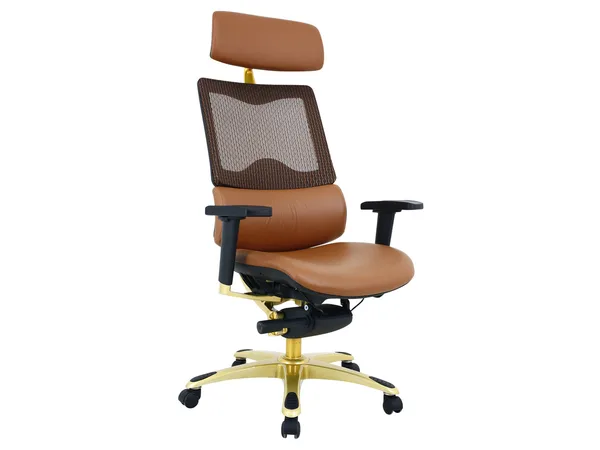
Brands that want to own a shelf — office, gaming and a couple of leisure pieces — usually start by asking whether one factory can keep the label consistent across all three. We can, and running it from a single plant is the straightforward way to do it. But "consistent brand" means different things on a mesh task chair than on a racing-style gamer, so let me be specific about what carries over for free and what has to be engineered separately.
What carries over for free
Your logo, your colourway, your carton artwork, your barcode and label placement, your warranty card and your fitting instructions — all of that is set once and reused across every category. When your office chairs, gaming chairs and leisure chairs ship from the same line, the woven label comes from the same supplier, the box print uses the same plate, and the embossed logo on the backrest comes off the same tooling family. That visual consistency is what makes a five-SKU range read as a brand instead of five unrelated imports sitting next to each other on a marketplace.
The packaging consistency is worth as much as the product consistency. A retailer or a marketplace buyer judging your range will notice instantly if one box is glossy and another is matte, if the logo sits in a different corner, if the carton dimensions are all over the place. One factory means one box spec across the range, which makes your range look deliberate. It also makes your warehouse and your freight planning simpler, because the cartons stack predictably.
What has to be rebuilt per category
The chair itself does not carry over, and buyers new to multi-category sometimes assume it should. A gaming chair's tilt mechanism, deep side bolsters and headrest pillow are a different bill of materials from a mesh office chair's synchro mechanism, and a leisure recliner's reclining hardware is different again. Each category needs its own approval sample and its own moulds. So the branding is one project; the engineering is three. We price them that way so you see exactly where your money goes and do not assume a discount that the physics will not allow.
One thing many private-label buyers miss: the gas lift and the base are where a brand quietly lives or dies. If you brand a premium office line and then accept a Class 3 cylinder on a chair that sits in an open-plan office all day, the warranty returns will damage the brand you just paid to build. The cylinder is the cheapest part to downgrade and the most expensive to get wrong, because a sinking chair generates a return, a replacement, and a one-star review. We push the cylinder and base spec to match the use, not the price target, on anything that carries your name — and we will show you the stamp on the cylinder so you can verify the class before production.
Keeping quality consistent across the range
A brand is only as strong as its weakest SKU. The risk with a multi-category range is that the office chair is excellent and the leisure chair is an afterthought, and the customer who bought both judges the brand by the worse one. Running all three under one QC standard helps here: the same inspectors check against the same approval samples, so the leisure chair does not get a lighter touch than the office chair just because it is a smaller line. We hold one quality bar across the range, and we would rather flag a model that cannot meet it than ship a weak SKU under your name.
The trade-off worth naming
Doing all three categories under one private label is cheaper per category on the branding side and more consistent on the shelf. The catch is lead time on launch: three approval samples take longer to align than one, and you should not rush them, because the signed sample becomes the reference we build the whole order against. A brand that approves samples in a hurry pays for it in the first production run, every unit of it. Build two to three extra weeks into your launch calendar and you avoid that — plan it into your overall timeline from the start.
We build and test to BIFMA and EN methods across all three categories, and testing can be arranged per order so your brand can show a report where the market asks for one. We will not turn that into a blanket claim before your configuration is in a lab — that is a promise we keep across every SKU you put our name on.
If you are planning a multi-category own-brand range, send us the categories and rough volumes and our ODM/OEM team will lay out the branding-once / engineer-three plan with a realistic timeline. Reach us via the contact page or [email protected].