Twice a year a distributor sends us their full price list and asks what we would add. Nine times out of ten the honest answer is "nothing — cut first." A typical mid-size seating catalog we see has 60 to 90 SKUs, and when we line them up against the sales report, the bottom third moves fewer than 50 units a year each. Those chairs are not a range. They are inventory with a photo.
Start with the ladder, not the chair
A range is a set of price points before it is a set of products. The pattern that works in seating is the same one that works across retail: an entry model that wins the price comparison, a mid model that carries the volume and the margin, and a top model that anchors the range and makes the mid look sensible. Three rungs per category is enough. Five rungs means your own SKUs compete with each other, and the customer who cannot decide buys nothing — or buys the cheapest, which is the worst outcome for your margin.
Run the ladder per category. In office chairs that might be a basic mesh task chair, a synchro-mechanism mid model, and a full-spec ergonomic flagship. In gaming the entry rung matters less — that market shops by look first — so two rungs often do the job. In leisure, where purchase frequency is low, one strong recliner at a fair price usually beats three that split the same demand.
SKU count: the discipline nobody enjoys
Every SKU you carry costs you four times: a sample, a listing, a slice of warehouse, and a slice of your team's attention. The chairs that pay that cost back are fewer than most catalogs admit. Our rule of thumb when we review a range with a buyer: if a SKU did not sell 100 units in the last twelve months and is not new, it needs a reason to stay — a strategic account that demands it, a colour that completes a set, a rung on the ladder nothing else fills. "We have always had it" is not a reason.
Cutting is also where the cash comes from. A distributor who trims 80 SKUs to 50 frees the deposit money that was spread across slow movers and can put it into deeper stock on the chairs that actually turn. Deeper stock on winners means fewer stock-outs, and fewer stock-outs are worth more revenue than the long tail you cut ever produced.
Build on shared platforms
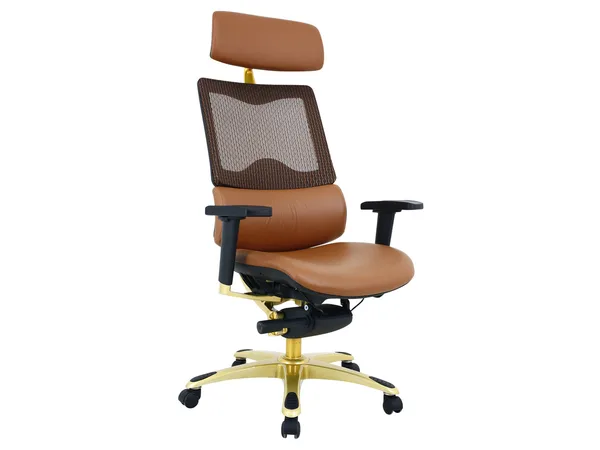
Here is the factory-side trick that makes a tight range feel wide: variants on a shared platform. One mechanism, one base, one cylinder spec — then two mesh colours, two fabric options and an optional headrest. To the customer that reads as six chairs. To us it is one tooling set and one production line, which means lower per-model minimums for you and faster reorders, because the platform parts are always in motion on our floor. When you brief a new range, ask the factory which models share platforms before you pick by photo. Two chairs that look different but share 70% of their parts are a better pair than two that look similar and share nothing.
Colour is the cheapest variety you can buy, but it is not free: each colourway carries its own fabric minimum and its own dye-lot risk on reorder. Two or three colours per model is the sweet spot we see. Ranges that offer six colours per chair end up with four of them stranded in the warehouse.
Platforms also quietly fix your spare-parts problem. When five models share one mechanism and one cylinder, you stock one service kit instead of five, and a warranty repair three years from now does not depend on whether a discontinued model's unique part still exists. Buyers rarely price this at launch; they always feel it in year three.
Plan the refresh before you launch
A range is not finished at launch — it has a clock. Gaming styling dates in two to three years; office and leisure run longer. Decide at launch which models are core (kept and reordered for years, where you protect the approved spec rigorously) and which are seasonal or trend models you expect to replace. That decision changes how much you invest in each: core models justify custom tooling and deep marketing; trend models should ride existing platforms so you can drop them without writing off tooling.
The refresh cadence also sets your ordering rhythm. A distributor running six to ten containers a year does best refreshing one category per year on a rotation, rather than relaunching the whole catalog at once and discovering that three categories of new samples, new listings and new photography all landed in the same quarter.
Where a full-range factory fits in
The reason we see so many catalogs is that we make all three categories under one roof, so a range review with us covers the whole price list, not one supplier's slice of it. We will tell you which of your SKUs map onto shared platforms, which rungs of your ladder are missing, and — because we would rather have your volume on fewer, faster models — which chairs we think you should stop buying, including from us. A tight range that reorders predictably is a better account for a factory than a sprawling one that trickles, so the advice is not charity.
If you want a range review, send your current price list with rough annual quantities per SKU and our ODM/OEM team will map it against ladders and platforms and come back with a keep/cut/add view. Start through the contact page or write to [email protected].